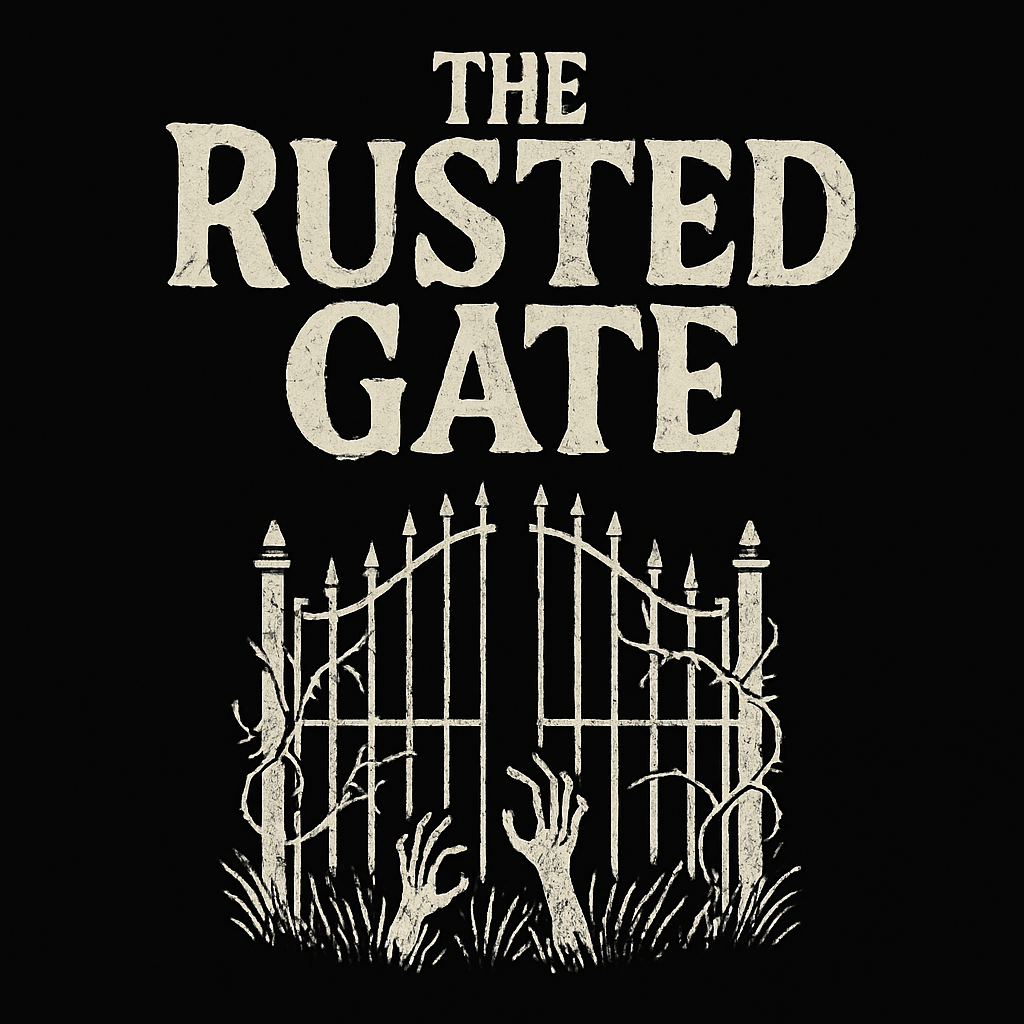
The Rusted Gate
They told the story like it was a dare, the way kids whisper to each other with giggles cupped behind their hands: Go on. Touch it. The daring part, as always, was the gate—its teeth of iron bent inward like a mouth that had forgotten how to close. It faced the road at a crooked angle, as if someone had tried to drag it away in the night and, failing, left it there to sulk like a wounded thing.
By day, you could mistake it for ordinary ruin. The posts leaned. The hinges were orange with rust and swollen with old rain. Vines looped their green script through its grillwork, spelling a language the wind read aloud. When cars rolled by on the distant lane, dust plumed and drifted and settled like a gauze veil over the field behind it—a field with no cattle, no scarecrow, no purpose. Just grass that grew in uneven swells, as if bunched by the fists of something below.
By night, the field looked like water. Moonlight slicked every blade of grass so the whole Yard breathed in a slow tide. And the gate—ah, the gate woke. Hinges exhaled. Iron sighed. The latch trembled like a jaw clenching against a cry. That was when the voices were said to start: not words at first, but syllables the way a baby’s lips try them—ah…oh…ee—until the vowels lined up like vertebrae, a spine that could stand, a sentence that could bear weight.
“Come in.”
The dare happened, the way dares do, on a Friday night between the seasons when the town couldn’t decide if it was done with summer or finished with fall. Gracie Hale hid a cigarette under her sleeve while her brother Mason kicked a bottle cap down the road. They were seventeen and nineteen, too old for the kind of fear their father had raised them on, too young to know fear was patient.
“Don’t,” their cousin Elle said. A head shorter, all freckles and iron will, she wore a red hoodie zipped to her chin like armor. “It’s just a field.”
“Exactly,” Mason said, twirling the bottle cap on his thumb and flipping it with a metallic plink into the ditch. “Just a field with a fence and a story. We’re here for the story.”
“Our father would—” Gracie started, then stopped, because the sentence ended with a ghost they weren’t ready to summon.
They’d parked their dad’s old truck in the turnoff and walked the last quarter mile. The road here forgot its own lines and the reflectors blinked like tired eyes. On their left: scrub trees and a creek that ran whether anyone noticed or not. On their right: The Yard, capital letters deserved, a place the older folks said was never a place but a feeling where places went after they died. Somewhere in the black middle of it, the DollHouZe settled like a spider—its peak hidden behind the roll of land, its windows the color of a thought you tried not to think.
“On three,” Mason said. “Gate touch and back. We’re not going in.”
“We aren’t going anywhere near—” Elle began, but Gracie’s hand had already found Mason’s. They counted like children, because children know how to do difficult things: together, fast, holding breath. One, two—
The third number died on the gate’s hinge. It wasn’t a creak. It was a sigh, human-sad and very old. The latch lifted by itself, scarcely an inch, a shy nod. An invitation written in the language of doors.
Elle didn’t scream; she told herself that later. But she did say no in a voice that pulled the air tight around the syllable. “No.”
Mason grinned too wide. That was how he handled fear—stretched it into comedy until it snapped back and cut him. “After you,” he told the gate, because he always liked to be charming to traps.
Gracie had their father’s eyes. She looked into the Yard and felt the clock of her childhood click backward: front porch stories, a beer sweating in the man’s hand, his voice lowering when he said rules. There had been three.
“Never count the stones,” he’d said. “Never listen if the empty speaks. And never—never—open that gate.”
Why? she’d asked.
“Because the gate opens you back.”
She should’ve said the words out loud now, drawn them across her siblings like a chalk circle. Instead, she squeezed Mason’s fingers and stepped forward, because that was how love worked in their house—danger first, explanations later.
The gate was cold, but not the kind of cold iron should be. It was the temperature of a memory. When Gracie’s palm laid flat on it, she felt a pulse. Once. Twice. Like something inside it had a heart.
Mason laughed and slapped his palm next to hers. “Boom,” he said. “Dare done.”
The gate breathed in.
They felt it—the metal stretching a fraction, as if the space between the bars widened to accommodate lungs. The latch shivered, rose, fell. Somewhere in the field, a swing moved though there was no wind, and the chain turned, and links spoke to links in the old gossip of iron: Remember. Remember. Remember.
“Okay,” Elle said, backing away. “We’re leaving.”
The hinge did what old things should not do: it chose. With a gentleness almost careful, the gate unlatched and opened toward them, not enough for a person to pass, just enough to change the shape of the night.
A smell came out. Not rot. Not damp. It was the smell of the inside of a chest you find in an attic and, against your better judgment, open: paper, cord, a thread of something medicinal that says what was kept was kept for a reason.
Gracie removed her hand. The pulse remained in her palm, echoing. A phantom second heartbeat under her skin. She stared at the field and saw a line of uneven hills that might have been old mounds, might have been animals sleeping, might have been the earth learning to breathe the human way.
“Gracie?” Elle said softly.
“Shh,” Gracie answered, because the quiet had changed. It wasn’t absence—it was a stage between words. The pause a mouth makes when it decides to say yes.
At the far end of the Yard, a pale light bobbed like a held lantern. It moved slowly, not in a straight line but with the patient meander of someone counting while he walked. There was a rumor here about a boy called 8. Gracie remembered it now: a child who counted graves until numbers nibbled away his name, a bargain in a lantern, a flame full of trapped voices. She didn’t believe rumors. She believed the look Mason got when he decided a thing was fun.
“First to the fence post wins,” he said.
“Don’t you—” Elle started, but Mason was already running with the arrogant grace of a small-town boy who’d outrun everything that wanted to teach him otherwise. He slid through the gate sideways like a note between bars and sprinted into the field, his laughter scattering the careful hush.
“Mason!” Gracie called. Her sneaker crossed the threshold before she could stop it. The grass laid down where she stepped and put itself back up behind her like someone making a bed in a hurry. Cold fog licked her ankles. The gate swung an inch more.
Elle didn’t move. She knew one truth the others didn’t: sometimes the bravest thing you can do is refuse. She held her place on the road, fists at her sides, and said no to the dark the way you say no to a stranger who knows your name.
The light out in the Yard paused, as if hearing itself watched. It turned toward them. Not a lantern, Gracie thought—not exactly. It was a throat with a stone of brightness lodged in it. It pulsed. Once. Twice. A heartbeat answering the pulse in her palm.
“Mason,” Gracie shouted. “Back.”
He waved without looking. “Fence post!” he yelled, joy-drunk, and touched one of the leaning markers at a run.
The post moved. Not much. A polite inch, like a man in a crowded church making room on the pew. But it was enough for Mason’s fingers to slip off, enough for his balance to go wrong, enough for the ground to tilt its working mouth.
He fell the way a boy falls when gravity remembers his name. Grass opened. His knee struck earth with a sound too hollow for soil. By the time Gracie reached him, he’d already started to laugh it off—I’m fine, it’s fine, don’t be dramatic—but the laugh collapsed in a gasp because the ground under his palm exhaled.
Hands, someone had said in a bar once, when stories were ugly and needed beer to slide down. Hands in the Yard. Not metaphor. Not a poet’s idea. Hands like vines with finger bones braided in. Hands that didn’t choose between push and pull but understood the sacrament of both.
One of them touched Mason’s ankle, not hard, not cruel. A tap, a claim.
Gracie grabbed his wrist and Elle—who had run despite herself—took the other. “Up,” Elle said. “Now.”
In fairy tales, a single effort saves. Reality is more expensive. It took all three: Gracie’s stubbornness, Elle’s anger, Mason’s sudden, blessed fear. He came free with a wet sound the earth swallowed to be polite. All at once, the light out in the Yard glowed brighter, as if someone breathed on a coal.
“Go,” Gracie said, and they went without elegance, a scramble on all fours for the angle of the gate. The field did not forbid them, which is worse—when the trap allows escape once so you’ll trust it next time.
They spilled through the mouth of iron and collapsed onto the road. Gravel left its parentheses on their palms. Gracie looked back, because she had her father’s eyes and they never learned the lesson of don’t look.
The gate was closing with the patience of a coffin lid. The light turned away and resumed its counting. In the quiet that followed, she heard a number enter the dark like a nail tapped into wood.
Eleven.
“Never again,” Elle said, hugging her knees.
Mason tried a joke and failed it. “Fence post cheated.”
Gracie didn’t answer. She pressed her palm flat to the road and felt the echo there, the faint second heartbeat the gate had gifted her. It would go away, she told herself. Or it wouldn’t. Either way, she had a new rule.
They drove back with the windows down though the air was cold. The truck’s radio crackled with the town’s one station—late-night calls, weather, the country song about a mistake you keep choosing. The moon ran alongside like a dog that wanted to be let in. When they reached the house, Gracie didn’t need the porch light to know their father would not be sitting there with his beer and his rules. He’d been gone a year now, the way people in this town left: in the afternoon without a goodbye, or at night with too many.
Inside, the kitchen smelled faintly of coffee and lemon soap. Gracie washed her hands until the water ran so hot it astonished her. The second pulse in her palm beat against the spray, stubborn as a clock down the hall from a room you swore was empty. She shut off the faucet and listened.
From the dark outside, through the sink window, she thought she heard a chain move—link to link, telling its old stories. Remember. Remember.
She went to bed and dreamed the gate had moved from the road to their hallway. In the dream, it opened because she asked it to, because politeness is a language even iron understands. She walked through. She woke with the taste of dust.
For a week, they didn’t speak of the Yard. Ordinary stepped in and demanded its shabbily made bed: work at the deli for Gracie; shifts at the feed store for Mason; Elle’s homework in piles like small gravestones with math carved on them. The pulse in Gracie’s palm grew fainter. Sometimes she could not find it. Sometimes it found her.
On the eighth night—it’s always the eighth in stories that mean it—the phone rang after midnight. Gracie, light sleeper by choice, answered on the first ring to keep it from waking the others.
“Gracie Hale?” The voice was male and had borrowed its confidence from somewhere. “This is Deputy Weller.”
He said there’d been a trespassing call out by the old fence line. Boys from the neighboring town. Skulls shaved smooth, thrift-store bravery. One missing now. The one who called said there was a light in the field.
“We were told you… know the place.”
It wasn’t a request. It was the kind of sentence lawmen use when they’re going to do the wrong thing and want someone to give them permission.
“I know the story,” she said.
“That’s all I wanted to hear,” he lied. “You’ll meet us there.”
She left a note for Mason and Elle that said don’t. She hoped they would obey the word the way she never had. The truck started on its second try, like a heart reconsidering its duty, and she pointed it at the dark she had pledged to avoid.
The Yard looked different with official cars parked along the ditch. Red and blue lights made a carnival of the grass. Deputies stood in clusters by their doors and pretended not to listen to each other’s fear. The gate had been pushed wider, which offended Gracie—opening is a kind of intimacy you earn, not take.
Weller had a mustache full of the town’s older laws. “You,” he said, gesturing. “Inside?”
“No,” she said.
He waited. Men like him knew silence could be a hand on a steering wheel.
She sighed. “The missing one. You’ll not find him by walking. You’ll only increase the count.”
“Count?”
“Graves,” she said, and let the word be as heavy as it wanted. “You brought light?”
He held up a flashlight like a truce. She shook her head and pointed at the field where, faint and regular as breath, the other light moved.
“Don’t follow with yours,” she said. “Follow with your voice.”
“What?”
“Call him home. Say his name the way his mother says it when he’s sick. Mean it. The Yard likes manners. It pretends not to.”
He looked at her with that expression authority wears when it tries on humility and finds an old suit that still fits. “You’ll go with us.”
“I’ll stand at the gate,” she said. “I’ve already given it my hand.”
“What?”
“Just go.”
He went, and three with him, and three more because no deputy goes alone into a story. They did not raise their lights. They spoke the boy’s name like prayer, which is the oldest technology. Evan, they called. Evan, Evan. The field listened. It loves its name called. It believes that means stay.
The counting light paused then, as if it remembered something. Gracie wondered if the Keeper felt irritation when police walked his rounds. Did the lantern drag him? Did he, too, desire an ordinary bed, a faucet, a lemon smell? She pressed her palm to the cold of the gate and felt, very faint, the second heartbeat answer.
She counted with the Keeper, because if you can’t stop a thing you can at least agree on its rhythm. Eleven, twelve. She thought of her father saying rules and of Mason’s laugh snapping back and cutting him, of Elle’s small back turned into courage on the road.
Evan came out of the grass by himself. He did not look at anyone at first. He looked at the field the way sailors look at the ocean when it decides to be ship instead of water. Then he looked at Deputy Weller and blinked like a child waking from a fever.
“You came,” he said.
“We did,” Weller answered, as if he had done something brave instead of something barely acceptable.
Gracie watched the counting light turn away with a patient insult. One that got away is a story the Yard permits because it makes the other stories better.
She stayed until the deputies left and the field returned to its own sound. The gate moved a hair, as if the night needed to rearrange itself to be comfortable. She might have walked away then. She might have gone home to the bed that smelled like old laundry and forgiveness. Instead she spoke, very quietly, not to the field but to the figure who walked it.
“I know the rules,” she said, and her breath made a small cloud that drifted between the bars and was adopted. “I will keep them.”
The light paused. It did not turn. It pulsed once in acknowledgment—colleague to colleague. Then it went on, and the chain of the far swing took up its gossip again. Remember. Remember.
On the drive back, she rolled the window down and let the night take her cigarette like a tithe. She would not go back, she told herself. She would keep everyone out. She would be her father’s rule finally obeyed.
But fear is patient, and love is a dare you keep choosing. Weeks later, when Mason decided the town did not own him and the Yard did—when he said the word fence like it was a country he’d emigrated to—Gracie would show up at the gate with a rope and a prayer and a new rule made of the old ones.
Never count the stones out loud.
Never listen if the empty speaks your name.
And if the gate opens, you do not go in—
—you go get your brother.
The Yard waited. It always does. It had all the time in the world, and then some it borrowed.
It watched the road where trucks learned their errands. It heard the town stitch itself with Sunday bells and Saturday sirens. It smelled coffee and lemon soap through a kitchen window a half-mile away. The gate kept its rust, which is a kind of memory. The grass perfected the art of laying down and standing up between footsteps. The chains told their stories to each other and nobody else.
And at night, when the moon made a lake of the field and the counting light kept its rounds, the Yard practiced being a mouth. It learned to open a little more kindly. It learned the shape of welcome the way a predator learns the shape of prey’s kindness—by pretending it back.
When you pass on the road, if you are the kind who sees, you will see how the iron leans. You will smell the attic odor of kept things. You will feel a second heartbeat in your palm as if some door inside you had a hinge you’d never noticed.
And if you are the kind who listens, you will hear a number in the dark between the deputies’ footsteps and the swing’s chain.
Twelve.
Then silence, patient as a jaw.
Then the small exhale gates make when they forgive themselves for opening again.
Welcome to "The Yard".