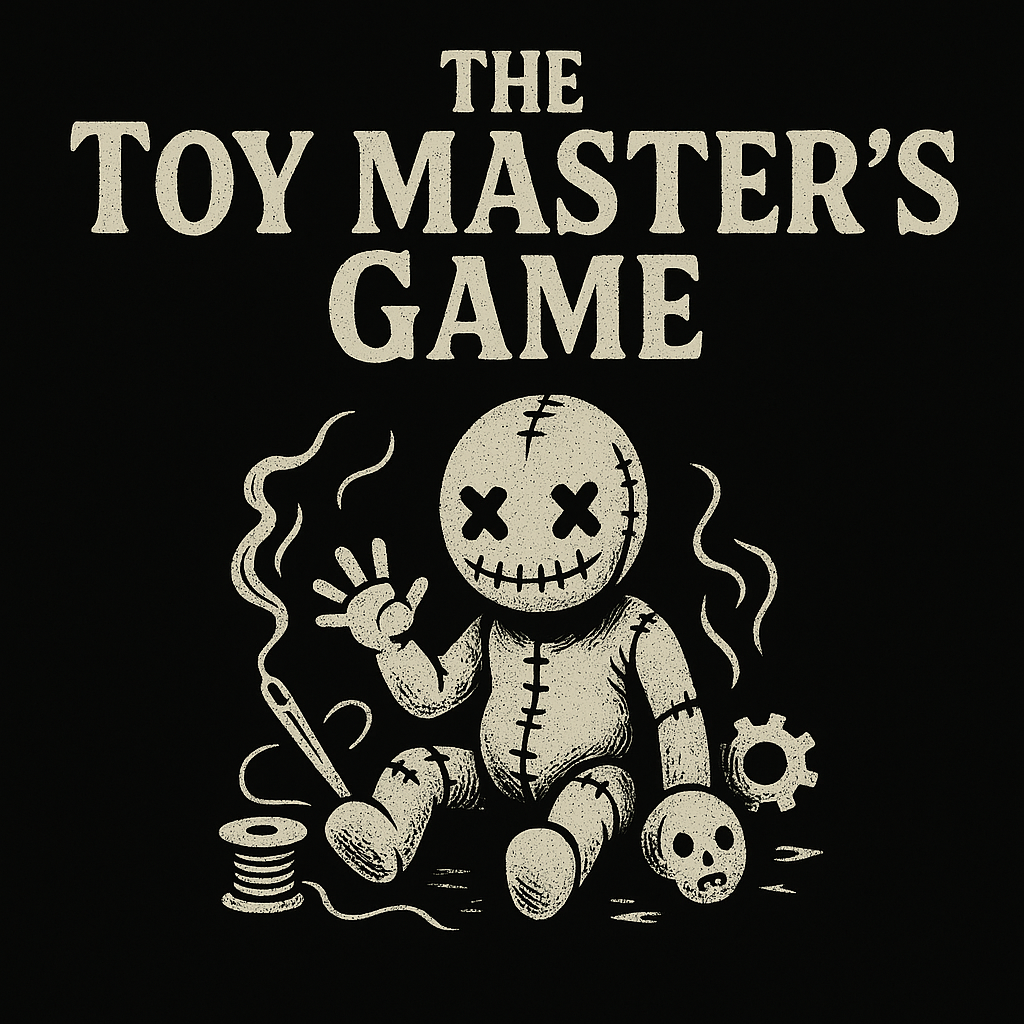
The Toy Master’s Game
The first toy Apollo ever made from The Yard did not want a name.
He found the parts where the wind sorted the town’s lost things into piles against the leaning fence: a single button with a hair still looped through its eye, a splinter of painted wood that remembered being a horse, a length of wire bent into a question mark, cloth the color of milk left on a porch overnight. He sat on the cracked slab beneath the swing set—two concrete feet that had forgotten their legs—and arranged the pieces until they argued less.
“Stay,” he said—not to the toy, not yet, but to the feeling that everything he loved would walk away if he looked at it too long.
The Yard listened. The Yard likes verbs. It keeps them like seeds and waits for weather.
Apollo was small for twelve and stubborn for thirty. He built because no one had taught him how to pray. He stitched with fishing line because thread didn’t trust him. When the button wouldn’t sit, he palmed it hard and pressed until the wire sighed and agreed to be an eye socket. He bit the line and tasted copper when the needle pricked his tongue. The Yard took that taste the way artists take light.
Behind him, a chain murmured. Not wind. Weight—the kind a lap makes when a child climbs in without asking.
“You’re late,” said a voice like paper torn slow.
Apollo looked up. The DollHouZe did not stand in front of him so much as occur there, the way a thought occurs: windows black, peak too sharp for roofs, porch a mouth that had given up on being door. If you stared long enough, the molding carved itself into faces that regretted being seen.
“I’m not late,” he said, because he’d learned early that whether or not you answer a thing matters less than how.
The door opened onto a darkness that had opinions. “You brought me tribute,” the voice said. It was a woman’s voice if a woman could be a knife. “Good boy.”
“It’s not for you.”
“Everything is for me,” the voice said, and somewhere inside, a hundred ribbons rustled like the hems of a governess’s dress moving through a school of bad children.
He bent back to his work to keep from being eaten by conversation. The toy’s face came together: wire eye asking; sewn eye listening. The wood settled into the cloth like a bone remembering muscle. He tied a knot too tight and felt the pressure of the Yard answer it in his gut.
“Now,” he told the shape in his hands. “Stay.”
The toy stayed.
Not because gravity consented. Not because he’d tied it down. It stayed because the dark beyond the open door breathed the word after him and made it a law. Stay, the DollHouZe said kindly, which is how you should always speak to children you plan to ruin.
The toy blinked with the eye that had never been an eye. It turned its face toward the house and tilted, as if hearing its maker’s name spoken from far away.
“Apollo,” the DollHouZe said, and the syllables fitted him as if they’d been measured. “Come in. Bring your little god with you.”
“Not a god,” he said, tucking the toy under his jacket and tying the sleeves at his waist so it wouldn’t fall. “Just a game.”
The porch wood creaked with a laugh that never made it to sound. “Oh, child,” said the voice. “You’ve never played a real one.”
Something out in the grass began to count—not numbers, but pieces: a button, a wire, a bone, a boy. Apollo felt the tally slide through him and click. He didn’t believe in rules except the ones his hands made with thread. But when the house said come, his feet found the stairs. The toy warmed against his stomach. Its wire eye turned toward the dark, and the bend of the question smoothed into something that looked like an answer.
He went inside.
Inside the DollHouZe, corners occur where corridors should go, and every corridor leads back to a corner that has been watching you arrive. The air smelled of starch and lavender gone wrong. Framed photographs of people who didn’t remember being photographed watched as he passed. The staircase rose like a reprimand.
She met him on the landing: the one the whispers called The Governess. Her gloves were made of rules. Her hair was pinned up with pins that had been other things first. Her face was a lesson that had survived the child who needed it.
“Show me,” she said.
He opened his jacket and let the toy sit in his palms like a question that had been waiting for the correct mouth. The toy cocked its head at the Governess. She cocked hers back, a mirror absentmindedly pleased with its owner.
“You made it with verbs,” she said.
“I made it with junk.”
“Junk is nouns,” she corrected gently. “You told it stay. That is why it stays.”
She walked him into a room whose wallpaper was small, repeating girls in small, repeating gardens. In the middle stood a table with legs like scolded dogs. She set a lantern on it, cracked and soot-stained, a twin to the one carried beyond the fence by the boy who had become The Keeper. This flame, though, was smaller—a pilot light of obligation.
“Would you like your toys to keep you?” she asked, and her voice softened in the way danger softens when it wants to be invited in. “To keep your room from emptiness. To keep your name from forgetting itself. To keep the hands you love from letting go.”
Apollo thought of the way his mother’s laughter had left the house six winters ago and never wrote. He thought of the way his father’s temper returned without apology and refused to sit anywhere but the table. He thought of the patched places in his jeans and the patched places in his heart and the way both tore along old seams. He thought of being small forever while everything else grew legs.
“Yes,” he said.
“Then here is the bargain,” said the Governess, and the doll-papered walls leaned in to listen. “I will teach you to stitch motion and memory into matter. Your toys will do as they do in dreams—move when unlooked at, choose when unasked. In return, you will owe me one laugh per toy.”
“That’s a silly fee,” he said, because he was twelve and brave in the way that we survive only once.
“Laughter is the cleanest bite,” she said. “Grief leaves grease.”
“What if it doesn’t laugh?”
She smiled the way a ruler smiles at a straight line. “They always do. Even the quiet ones.”
“I don’t have… much laughter.”
“The world does,” she said. “Your toys will find it and deliver it to me. A tithe. A manners tax. You’ll hardly notice.”
He looked down at the toy in his hands. It looked up at him, the wire of its question turned faintly toward his face. “You’ll stay?” he asked it, and knew how foolish the question was even as he asked.
The toy nodded, because kindness is a language even stitched things know.
“I accept,” he said.
“Of course you do,” said the Governess, and somewhere a ledger closed itself and went to sleep with a satisfied sigh.
Word traveled in the way it travels in towns that keep their disasters in glass cabinets. The first of Apollo’s toys to play back was a tin soldier he’d found under the bleachers and soldered a copper heart into. When no one watched, its click became a tick and then a beat, and if you held it to your wrist, it borrowed your pulse and doubled it, a duet that made old women cross themselves and young men cross the street. A little girl named Mae took it home until it laughed once at a joke she didn’t tell and then refused to laugh again. Mae’s mother put the soldier in a drawer and locked it and later woke to find the drawer unlocked and the lock on the pillow beside her with a ribbon tied around it.
The second was a bear whose mouth never learned to close. Apollo fashioned it from a coat with a history and two buttons that had belonged together in another life and a stuffing that had previously been a pillow for the head of a woman who always dreamed she was drowning. The bear watched her sleep with one button of concern and one button of disinterest. In the morning it performed what her husband called a trick—it lifted a hand and patted hers and made a sound like a child’s first attempt at a bark. Everyone laughed except the woman, who cried because the bear had patted the exact spot where her pulse lived and had missed.
After the third toy—an articulated bird that preferred the rafters of the old mill to any home and learned to return when Apollo whistled—the adults began to forbid what their children had already decided. The pastor’s wife said the word unclean with the soft teeth of a prayer. The principal used the phrase safety protocol as if it were a fence you could see. The sheriff stood at the edge of the Yard and drew a line in the dirt with his boot and told Apollo, “On this side you’re a boy with a hobby. On that side you’re a problem.”
But the children came. They always do. They came with coins in a jar and broken buttons and stories of nightmares that needed small bodies to guard the door. Apollo sold nothing. He gave. The Governess approved; generosity confuses towns faster than theft.
The first time he felt the cost, it was in a laugh he didn’t make. A tiny tin windup man with legs that remembered being cloth toddled in a circle on the floor of the general store. Everyone laughed, including the butcher who never laughed and the teacher who laughed too loud to be believed. Apollo felt it then—a thread tugged from his chest the way a seam gives when you rise too quickly. The Governess’s lantern took the sound, folded it like linen, and put it on a shelf. The tin man stopped circling and looked directly at Apollo, almost apologetic. It did not laugh again.
Over weeks, he learned the rules written in the parts of sentences that adults don’t say. He kept a notebook in pencil and hid it in the rafters of the old shed behind his father’s rented house.
One laugh per toy. Mine or borrowed, always delivered.
Never name a toy after the dead. It will go where its name is.
Blood binds, spit bargains, tears pay twice.
The Governess prefers manners to miracles. Use “please,” survive.
He learned to fashion gears from quiet. He learned that cloth remembers what it has covered and wood remembers the hand that splintered it and buttons are the most disloyal of all, always wanting to go back to their last coat. He learned that every toy wants to go home, and if you give it no home, it will make one of you.
Parents came secretly at night the way people come to old graves with new flowers and promises. A man named Rauh stood in the shed doorway with his hat in his hands and said his daughter had drowned in the quarry two summers ago and the house had been hollow of sound since.
“Make a doll that will laugh in the kitchen,” Rauh said, “so my wife remembers that the air isn’t made of knives.”
Apollo wanted to say no and discovered he did not know how. He sat on the floor with cloth that had dried someone else’s laundry long ago and buttons that had belonged to a child who survived and a ribbon that had tied a birthday box to a day it would always envy. He stitched a mouth he wanted to be kind and failed with a mouth that knew more. When he finished, the doll did not look like Rauh’s girl. That was mercy. But it held its hands the way she held hers and kept its feet a little too far apart like a child trying not to fall.
In Rauh’s kitchen, the doll laughed once at a spill of flour. The sound was small and very clean, like a spoon laid gently in a drawer. Rauh’s wife made a noise and put her head down on her arms, and the doll tilted its face and learned the shape of grief you make when you are grateful for pain because it is at least not empty.
The Governess’s lantern brightened, accepting the toll. The doll never laughed again. It sat in the window and watched the Yard as if it contained the missing seasons.
“Enough,” the pastor told the sheriff. “Enough,” the sheriff told Apollo. “Enough,” Apollo told his hands, but his hands believed the Governess more than they believed their boy. He had said stay once to a world that wanted to go and the world had heard him and so it stayed, and once a world says yes it has to keep saying it until someone teaches it no.
The game began without permission. It began as all games do—with marks on a floor. Apollo woke one night to find chalk lines drawn in a board he did not remember drawing. Little squares and circles like rooms and doors. He set his feet in one and felt the square refuse. He stepped back and watched as the bear took position and the tin soldier clicked forward exactly three steps and the bird perched on the closet ledge and the doll in Rauh’s kitchen turned its head one notch toward the north.
“This is how you play?” he asked them.
They did not answer because answers are for rules and they had only invented a pattern. The Governess approved. Patterns keep children occupied until their bones are ready for grown-up work.
The children who visited in daylight whispered that the toys were playing without them. At night teens crouched by the windows and dared each other to listen. The game ran itself—no audience, only witnesses. The squares meant safe. The circles meant cost. If a toy crossed a circle, it owed the laugh if it had not paid, or it owed something else if it had. The something else changed every time, which is how you make a game you never finish.
“Stop,” the sheriff said, but he was talking to weather. “Stop,” the pastor said, and he burned his throat on the syllable. “Stop,” Apollo told his hands, and they paused like a dog at the end of a leash, then leaned again.
One night, the Governess brought out her ledger and pointed with a gloved finger, and the finger was a needle.
“Balance,” she said. “You owe me a toy that laughs forever.”
“That’s not… a thing,” he said. “Laughter is breath, and breath is counted.”
“Then give me your count,” she said. “Give me nights and the part of your name that knows where to return when called. Give me your fear of emptiness in exchange for emptiness’s fear of you.”
“What do I get?”
“You get to be what you already are,” she said.
He understood then that the bargain had not begun in this room. It had begun under a dead swing with a word he had said to keep a feeling from walking away. Stay. He felt suddenly very small, which is to say he felt his exact size.
“Teach me the seams,” he said quietly.
She did. She taught him how to cut gears from quiet and how to stitch thread from promises and how to tie off a knot in such a way that time itself will worry it with its teeth and fail. She taught him to soak cloth in water from the cracked basin on the DollHouZe’s second floor—the basin where women had washed grief from little dresses. She taught him which scraps of wood remember being ladder rungs and which remember being headboards and how to tell by smell which one wants to rise and which wants to lie down.
He learned quickly, the way children learn what keeps them alive. He bled on everything. The Yard drank and was polite about it.
The “Forever Toy” took a month to name and an hour to make and a lifetime to pay for.
He used a face cut from a sailor’s duffel that had crossed the world and lost track of its owner in a place with a name like a cough. He used a key he found under the school bleachers—a key that had never belonged to anything it could open—and he made the mouth a keyhole and the laugh a key. He lit no candles while he worked; the lantern on the table lit itself in small acknowledgments of debt.
When it was done, the toy lay there like a person who has always been lying there and simply now remembered to be seen. Apollo said nothing. Words felt like needles without eyes.
The Governess nodded to the toy. “Well?”
It looked at Apollo. It lifted its little head as if the world sat differently on its neck. Its laugh came out like a hand opening and then opening again and again as if someone had forgotten to stop shaking. The laugh kept happening. It did not echo; it took up residence. It moved across the floor like smoke and found the shelf where the Governess kept her other laughs and slid into all of them and married them into something bigger. The windows fogged and cleared and fogged in applause.
Apollo felt the tether snap. A portion of his soul crossed the floor in the same direction as the laugh and settled in the doll’s chest like a tenant with the right to renew.
“It will laugh forever,” the Governess said, and her smile left frost. “And so will you, from a distance.”
“I don’t feel like laughing,” he said.
“That’s why we keep it separate,” she said.
After that, the town called him Toy Master. Names know where they fit; the name fitted like someone had been waiting to say it since before he was born. The children said it with awe. The adults said it with the caution you use around an animal that knows the word home and therefore knows how to guard it. He put the name on like a coat and found it had pockets full of tools he did not remember acquiring.
But the game owned him, the way patterns own the eye that notices them. When he slept, the chalk re-arranged itself. When he woke, the toys were in new positions and the ledger on the Governess’s table had crossed out a line in a hand not her own and written something else. The tin soldier learned to move exactly three squares and then wait. The bear learned to place a paw over a circle and charge. The bird learned to fly from a circle to a square without paying, which meant someone else paid instead. Apollo learned that not all costs are his and hated the lesson and used it anyway.
He stopped going to school because the chalk there only said numbers that would never save him. He stopped visiting friends because their houses had corners that did not watch and this felt like betrayal to the corners that did. He stopped answering when the sheriff knocked because the sheriff always knocks like a man who expects doors to prefer him.
He worked. He whispered to his toys, “I will keep you,” and they believed him, which is the worst kind of magic—belief you cannot live up to.
The night he became what the Governess had always wanted him to be, the Yard hosted a storm that never wet the ground. Lightning stitched the clouds together without thread. The boy called 8 walked his perimeter with a lantern that pulsed like a taxed heart. The game drew lines on the floor no human hand would claim.
A child’s hand reached into a box beneath the swing and found a toy he had never made.
It was the Forever Toy’s smaller sister, mouth a smaller keyhole, laugh a smaller key, and when it laughed once, only once, the child laughed back and the lantern outside turned its face toward the house as if someone had knocked on it in a polite way.
Apollo went to the door and opened it and the Governess stood on the step with rain that did not fall wetting the edges of her sleeves.
“Title earned,” she said.
“I didn’t apply.”
“No one ever does,” she said, and the way she said ever made the porch older.
“What do I get?”
“You get to keep them,” she said, and gestured at the shelves where his toys stood—silent, expectant, like students who have learned the lesson and wish to see if the teacher understands it.
“And what do you get?”
“The game,” she said, and behind her eyes a thousand chalk boards arranged themselves and began without players.
From that night, the Yard had two keepers: one for its lost, one for its play. They never spoke. They did not have to. The lantern made rounds outside and the laugh made rounds within and between them lay a town learning to live with both.
For years after, when children could not sleep, mothers told them to play on the squares and not on the circles. When fathers felt their houses hollow, they held the toys to their chests and said you cannot have this laugh and sometimes the lantern passed their window a little more slowly and sometimes it did not. When teens dared each other to open the gate at midnight, the gate opened a polite inch and the chalk rearranged itself back home on Apollo’s floor as if to say, we are busy tonight.
Apollo aged and didn’t. He learned the weight of nights and the trick of putting days where they could not trample them. He learned which payments could be swapped and which had to be paid in the exact coin stamped with the exact face. He learned the Governess’s smile and learned not to return it and sometimes forgot.
He became a man whose hands never stopped making. He became a legend whose name children whispered and adults refused. He became a rule that the Yard liked, which is the only permanence a person can have in a place that refuses furniture.
When the wind is wrong you can hear the toys playing without you. When the wind is right you can hear the laugh that belongs to everyone and therefore no one and you will think of your own first laugh and wonder where it lives when you are not using it. If you stand by the fence and look toward the swing, you might see a box open itself by manners and not by force. If you reach in, you will pull out a game that has already started.
You will hold it. It will look at you.
And somewhere inside the DollHouZe, the Governess will put on her gloves.
And somewhere outside, the lantern will pause between numbers.
And somewhere in the chalk, a circle will draw itself around your feet with exquisite courtesy.
“Stay,” you will say without meaning to.
And the Yard will listen.